Archive for Interactive / Web

Building, A Brand


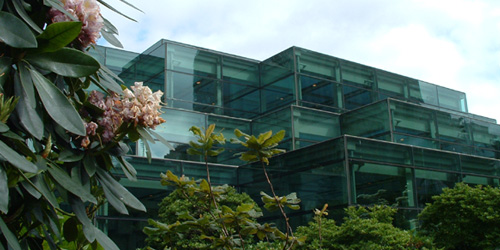
Washington State Convention and Trade Center building (back/garden) / photo taken 2003

Sometime in the 1940s or ’50s (I’m not sure of the exact year), the term “corporate identity” was coined by Lippincott & Margulies—one of the first major design firms in the world—to describe both the idea that even large businesses have inherent, relatable characteristics, not unlike human beings, and the practice that could express their character through a fitting, comprehensive and consistent design program. An organization’s identity is expressed in every way they communicate, from their name and logo to their brochures and web site, to the way they answer the phone—whether those “touchpoints” are designed by professionals or not—so this was an important “call-to-action” (to use another industry term) for organizations to pay attention to everything they were communicating, and, ideally, to pay top-notch professionals like L&M to help them make sure they were doing so effectively.

Sometime in the 1990s, the term “brand” began to take over as more formal business strategy was becoming more prominently integrated into large-scale identity design programs, and it quickly went from buzz word to industry category, on which uncounted firms jumped. I have always found this nomenclature shift ironic. “Branding,” literally translated, is the superficial process of stamping a logo on your property (livestock, originally); this superficial logo stamping is exactly the perception that the “new” practice of “branding” was supposed to be rising above. Meanwhile, the word “identity” could already encompass every aspect what an entity is, from what they do to how they express it. But like many P/C nomenclature shifts of late, whether rational or not, “branding” has taken hold, and “identity” (preceded by “corporate” or not), has been deprecated.

Whatever it’s called, my formal introduction to the process of figuring out what an organization stands for and expressing it in a fitting design program was in a class called Identity Systems in the Visual Communication Design program at the University of Washington, sometime in 2003. Like a few other courses in the program, this one was broken into collaborative group and individual phases. Three-person groups were assigned one of four or five major local entities and tasked with research and analysis of the entity, en-route to the creation of a strategic brand platform. Based on this platform, we were then set about designing a fitting logo and building a supporting visual identity system, individually… Read the rest of this entry »

Filed under Copy / Writing, Identity / Systems, Industrial / Product, Interactive / Web, Signage / Display

Comments


A Fast Train to Nowhere

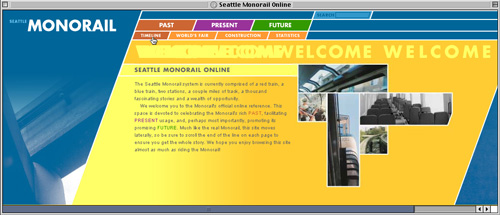
Seattle Monorail Online web site / Welcome page; 1020 x 440px. / 2002

Every time I visit Seattle (my hometown), which tends to happen more than once a year, I find it surprisingly different than I left it last. Startups become stalwarts, old favorites become new failures and areas of complete desolation become constructed destinations. But, until very recently, the ways to get to and from any of them had hardly changed a bit. Despite its squeaky-green image, Seattle has always been a car town, with a public transit system whose progress comes and goes in fits and starts but never seems to get anywhere useful by any reasonable timetable. As someone who grew up without a car and as a recalcitrant fan of progress (perhaps even Futurism, to some extent), one of the most personally frustrating examples of this city planning torpor is the Seattle Monorail.

As of 2002, when I decided to use it as it as my muse for a web site design class in the Visual Communication Design program at the University of Washington, the Seattle Monorail had been the beginning of something great for about forty years. Originally built in 1962 to shuttle visitors between downtown and the Seattle World’s Fair, the Monorail had since served as little more than an icon of the city’s once future-driven spirit, though there was a resurgent and concerted effort to evolve the system into something much more impressive. In fact, the wheels had been in motion, so to speak, for several years and, despite the work of some determinately opposed political factions, it looked as if the Monorail might actually realize its potential in the foreseeable future.

Even considering its terribly stunted scope of service at the time (it ran just over one mile, end-to-end—only about .1 mile longer than it had run in 1962), the Seattle Monorail was a fascinating entity, in that it was at once an historical landmark, a thriving attraction and the major source of inspiration for what possibly could have been the future of Seattle’s public transportation system. This web site was to celebrate the Monorail system’s rich heritage, facilitate its everyday usage and promote its promising future. As such, I architected the site accordingly, creating sections related to the system’s past, present and future, and built relevant content into each section… Read the rest of this entry »

Filed under Content / Architecture, Copy / Writing, Interactive / Web, Photography / Film

Comments (2)


Prosophobia

dpj_prosophobia_poster_front

Prosophobia promotional poster; 24 x 36in. / 2002

The most celebrated role of the designer has always been that of creator of positive change through innovation, but battling the public’s inclination to treasure the old and suspect the new has historically been tough going. The current of ominous world events (especially at the time of this project’s conception, painfully close to 9/11) only serves to shore up such public reservation. For many people, the comfort of the familiar is too valuable to risk on new ideas. This promotes a homogeneous, retro-centric design market in which the new is often merely another iteration of the old.

Prosophobia (“fear of progress”) was a concept for an international design conference that would explore why many of these constructs exist and how we as designers can continue to champion progress in this environment. Featured presentations were to be given by historians, behaviorists and economists, as well as a diverse range of design leaders successfully implementing progressive work, despite this prosophobic culture.

Being a design event (and a design school project, no less), a promotional / informational poster was a critical application, and set the visual theme for the balance of the comprehensive identification and communication suite. After several dramatic, antagonistic early concepts, including a God-like hand pushing down the sunrise, a Volkswagen “New Beetle” reversing into the viewer and even a revolver loaded with antiquities and ready to fire, an approach more considerate of both sides of the matter prevailed. The front presents the issue in a re-contextualized image reminiscent of the silent film era, showing a figure literally hanging onto the past for dear life, while the flip-side speaks to the present (signified by digital visual language) offering information on the voices on offer in the conference, and an invitation to participate in the future… Read the rest of this entry »

Filed under Content / Architecture, Copy / Writing, Identity / Systems, Industrial / Product, Interactive / Web, Naming / Words, Print / Editorial, Signage / Display

Comments


There is No “Inc.” in “Team”


UBC monogram mark for Union Bay Cycling / 2001

A competitive cycling team, like all other kinds of teams, is a of a group of people with a similar interest; in this case, the team’s chief objective is to win bike races. The primary vehicle of a cycling team’s identity is the uniform that team members wear out racing and training. This identity is complicated, however, by the fact that competitive cycling is one of the very few sports in the world based on a sponsorship model, whereby commercial interests pay for some aspect of team operations in return for visible recognition on these uniforms. Almost invariably, this leads to a team’s identity being inextricably intertwined with the identity of their lead sponsors, which can change relatively frequently.

For example, most people would say that Lance Armstrong raced the last season of his career with the Discovery Channel team, and that, before that, he was on the U.S. Postal Service team for six years or so, even though these were, for all intents and purposes, the exact same team, managed by Tailwind Sports.

Union Bay Cycling (UBC) is a large Northwest cycling organization built around an elite-level team that races in local, regional, and national events at the pro/am level. UBC has been around, with the same leadership and core group of riders, for over a decade, but major sponsorship changes had made it seem like three or four disparate and relatively short-lived teams. For UBC, I worked with the team director to develop a long-term solution: a core identity system that accommodates prominent and unique recognition for lead sponsors, but embodies the unique heritage and dynamism of the team riders and stays consistent even with major sponsor changes.

I began with the UBC monogram mark (above) that would immediately identify all communication touchpoints of the team: stationery for proposals, press releases and other correspondence, the web site, T-shirts, gear bags, and so on, and, of course, the all-important team kit, including jerseys, shorts, socks, water bottles, gloves, helmet graphics, and several other tertiary clothing articles.


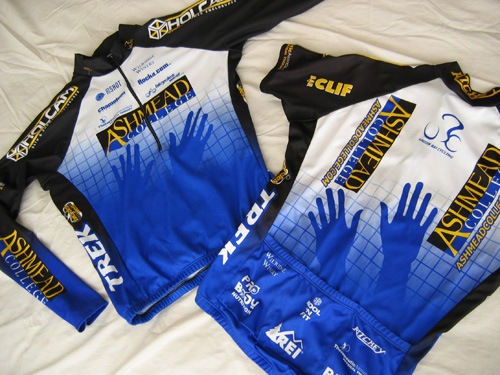
Union Bay Cycling jerseys (long-sleeve front | short-sleeve back) / 2003; I also happened to have designed the Holcam logo on the jersey shoulders (but not their web site) / 2001

The blue grid, an established device of the team, was reworked and became the foundation of this flexible system. The title sponsor was rewarded not only with the most prominent logo presence, but also with an expressive element emerging from the grid (in this case, the hands of Ashmead College, School of Massage), and other sponsors fit into pre-established hierarchical slots based on their respective levels of contribution…
Read the rest of this entry »

Filed under Content / Architecture, Copy / Writing, Identity / Systems, Interactive / Web, Packaging / 3-Dimensional, Print / Editorial, Uniforms / Apparel

Comments (2)


Please Get Down

I turned twenty-something once. Actually, I have turned twenty-something several times now. On some of these occasions, I have had parties (or get-togethers, as I like to call them). But once, I turned twenty-something and I had a get together and I decided to make kind of a big deal of it.

To build awareness of my upcoming event, I developed a whole campaign of advertisements that I ran on my web site (then eurodan.net), beginning about three weeks before the soirée, and sent “email-blasts” to all invitees with every new publishing. Seen below is the bulk of the series. (You can click on the images to see how they appeared on my site originally.)

I started with a very oblique teaser:

dpj_please_get_down_teaser.jpg

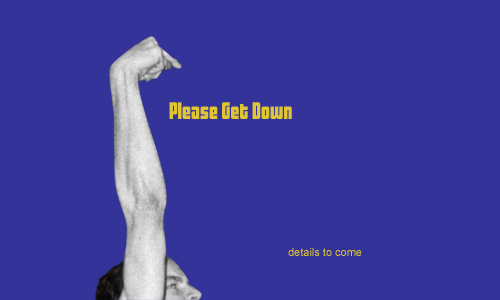
Please Get Down party announcement / teaser. (original photograph by Matt Johnson / 1995); I lifted the term “Please get down” from the most exasperated, impassioned plea in the jam-out-session of “Jolene,” probably the best song ever written/performed by Cake. | web site; 500 x 300px.+ / 2001

Read the rest of this entry »

Filed under Interactive / Web, Print / Editorial

Comments (4)


Stuck in the Middle

desk job

My first full-time desk job. Can you sense my enthusiasm? / 2001 (photograph by Lisa Torrence)

In order to engage context in a quotidian discussion about the various caste systems of ancient cultures, a feisty grad student T.A. in one of the many requisite Art History courses I have taken challenged our class section to define the contemporary stamp: “middle class.” Immediately, salaries rang out, one range louder and more determined than the last, until crescendoing in discordant numerical jangle; income could not objectively define it. Quietus gave way to a chorus of key possessions: Cars, houses. Okay, but what if the car is a Maserati? What if the house is a shack? Scenarios of familial constructs similarly swelled and crashed. These lines of criteria could not strike a clear chord of class definition.

The T.A. sat back and let the class caterwaul and self-dismiss various notions before bringing the struggling group back to cue. Coyly, he then rested the discussion by quoting a friend of his, who had jokingly defined a member of the middle class as anyone who “has a job.” The point of this was that such class distinctions are laughably vague and infinitely subjective (a job is not a job is not a job), but the passion with which people attempt to define them proved how deeply invested we are in socio-economic ranking.

While I had technically had three jobs prior, my quest for a “real,” middle-class-making job began sometime late in the Spring of 1999. I thought I had it in a full-time, long-term temp position “working with computers” that I had taken up after finally quitting my four-year run as a bike mechanic. Unfortunately, it wasn’t long before I realized that I wasn’t all that great at “computers” (at least, not in that context), and I let my hours decline steadily, until they were almost zero, and then they were zero. At that point, I had no income.

dpj_crash_results_1999.jpg

“Yo’ face is my case!” My head was barely scratched, but it did bleed a fair amount. Those scars on my arm are tire tracks, by the way. / 1999 (photograph by Ira Wamble)

As fortune would have it (if luck did not), I had been hit by a car that spring while riding my bike (two cars in the same accident, actually), which was an incredibly traumatic event that in turn paid me an agreeable insurance settlement. I ended up living on this modest reward, a tiny savings, and not much else for quite some time as my job search became more and more frenzied. By November, I paid rent by scrambling together the entirety of my bank account, the cash in my pockets, and loose change I had collected in a jar (seriously). The promise of middle class never tasted so sweet or came with such timely appreciation as when I was offered a job as an in-house “Junior Designer” at Sierra On-Line, Inc., just before Thanksgiving, 1999… Read the rest of this entry »

Filed under Interactive / Web, Packaging / 3-Dimensional, Print / Editorial, Type / Fonts

Comments


The Perfect Job

Sometime between the day I decided that I needed to get a real design job and the day that that happened, I realized that I should probably build some kind of portfolio. I picked up just about any project I could get my hands on and basically hoped for the best, since my relative inexperience denied any assurance of success (or financial compensation)… Read the rest of this entry »

Filed under Identity / Systems, Interactive / Web, Signage / Display, Type / Fonts

Comments (4)


The Beginning of the End (Literally)

Sisyphus painting by Titian

Sisyphus by Titian / 1549

Well, it’s finally happened: I have laid the groundwork to become yet another online asshole. Yes, now that I have joined the burgeoning ranks of the blogosphere, I, too, can make my opinion known to anyone in the world-wide-web with frightening ease and frequency.

Ironically, I used to publish opinion pieces about various personal and professional matters on my very first web site (then eurodan.net)—almost 10 years ago. However, at some point, I decided that my online presence should just be a relatively objective record of my graphic design work—basically, an online portfolio. I think this happened when I started becoming more concerned with seeming “professional” or something.

The pure portfolio sites (there have been several iterations) served me well, I suppose. In the late ’90s, the dot-com boom was deafening (especially in Seattle), and I knew that even my basic knowledge of digital media would give me an edge on my otherwise-more-qualified competition for design jobs, and I used it to good effect. Indeed, it was almost schtick: I wouldn’t bring anything to interviews—not even a resume; when they asked me if I had anything to show, I would casually mention “Oh, it’s all online,” as if anyone who had anything other than a web site for their portfolio was terribly passé. Keep in mind that hardly any of these jobs actually involved any digital media design. Nevertheless, my plan worked, for a while… Read the rest of this entry »

Filed under Interactive / Web

Comments (10)