Archive for Print / Editorial

American Realities


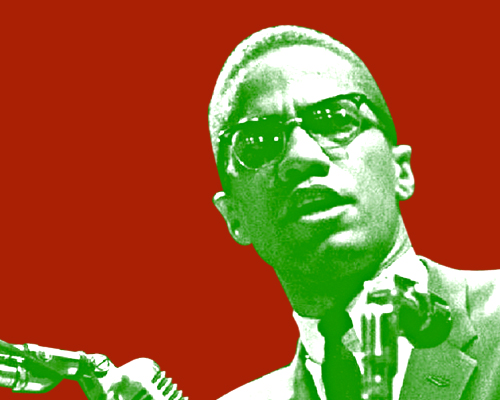
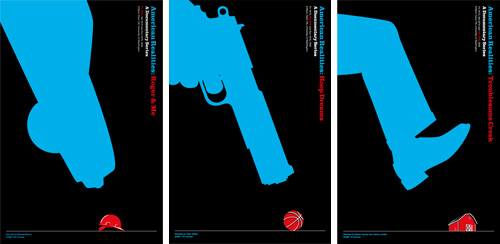
American Realities film series posters: Roger & Me | Hoop Dreams | Troublesome Creek; digital plot outputs; 24 x 36in. (each) / 2002

We Americans are conditioned to think that ours is the best country in the world—that this is the land of opportunity, and we can achieve anything here if we try hard enough. And, by all available evidence, there seem to be plenty of other countries in which people are a hell of a lot worse off than us. But life in the U.S. ain’t all sweet apple pie, and opportunities are easier to come by for some than others. Of course, you’d never know this by watching most film or television. With so much false “reality” pervading contemporary media, it is shockingly refreshing to see the true struggle of real life shown so eloquently in some powerful recent documentary films.

As one of three projects assigned in our Visualizations course in the Visual Communication Design program at the UW, we were to develop a theme around three movies of our choosing for a film festival of sorts, then design a corresponding promotional poster series. With American Realities, I thematically linked Roger & Me, Hoop Dreams and Troublesome Creek, as poignant revelations of Americans forced to work extraordinarily hard just to make ends meet, often against opposing forces of others’ opportunities.

By visually expressing the emotional tension of these stories, I aimed to generate awareness not only of these filmic case studies, but also of the true elusiveness of the American dream… Read the rest of this entry »

Filed under Advertising / Campaigns, Copy / Writing, Drawing / Illustration, Print / Editorial

Comments


Construction in Cities; A Design Marathon


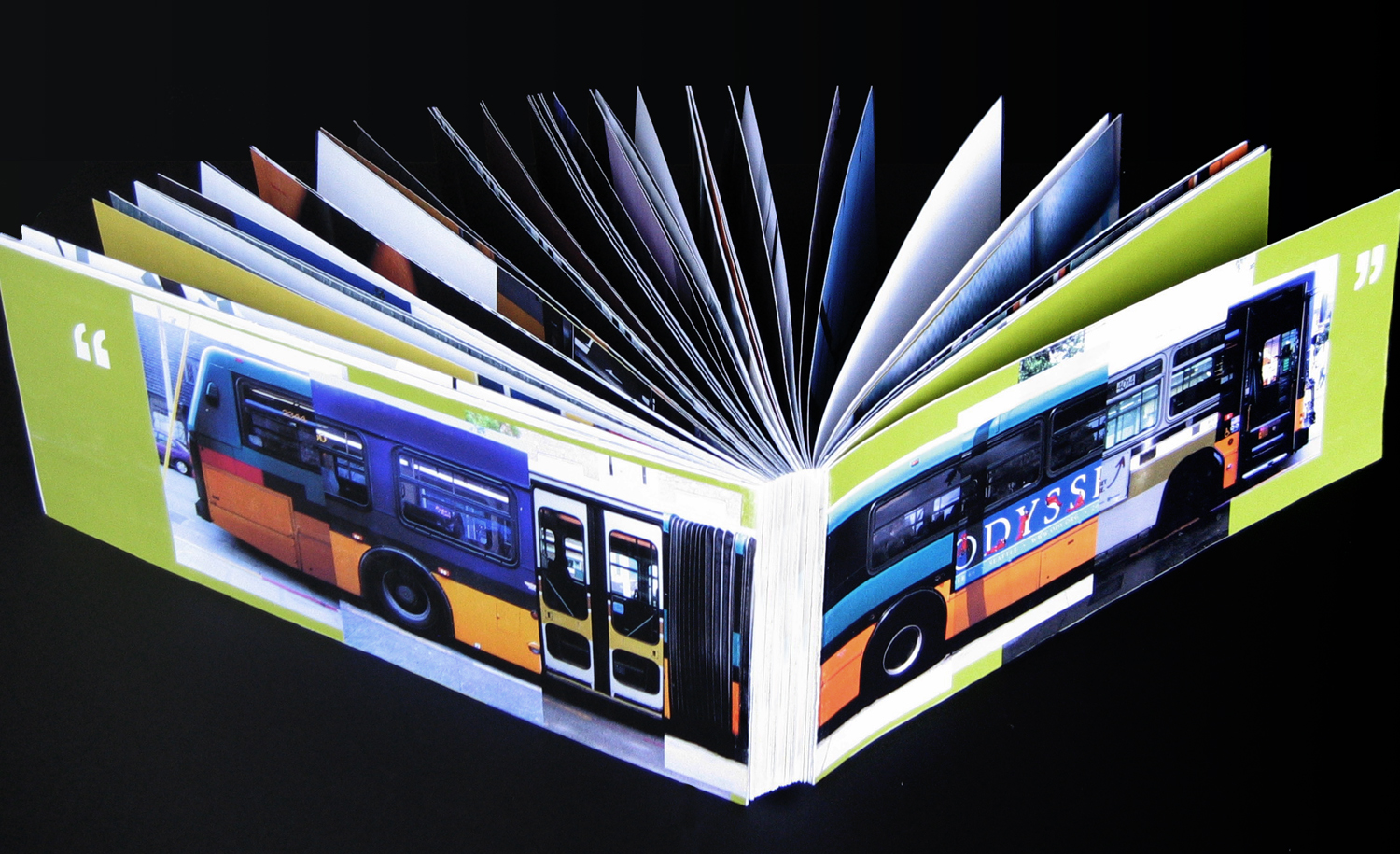
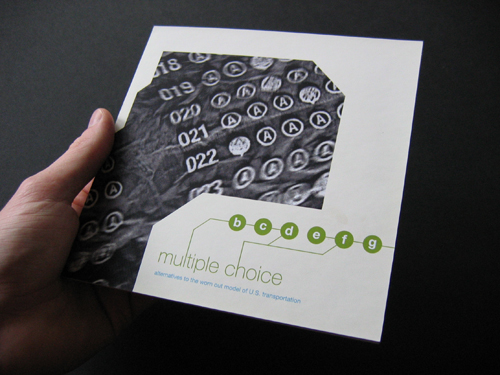
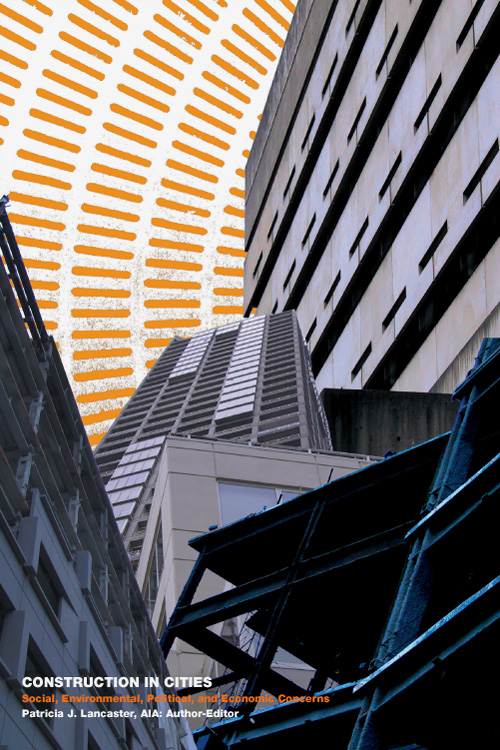
Construction in Cities; Social, Environmental, Political and Economic Concerns book cover (1 of 36); 6 x 9in. / 2002

There’s more than one way to skin a cat, as they say. They don’t seem to say who the desperate soul was that figured this out, or how many ways he or she came up with (though I imagine there must be at least nine). The question we were posed with in a university class project was: How many ways can you skin a book?

As part of the Visualizations course in the Visual Communication Design program at the University of Washington, this so-called “design marathon” charged us with creating not just one or even nine, but 36 different covers for the exact same book. Said book had to be a real, published work, and it had to have some variant of the word “city” in the title but, as long as it fit within those parameters, we could choose whatever one seemed to suit our fancy. We spent about a week focusing on getting a few covers started, then worked on developing the balance while concurrently working on a public service campaign project and another project creating a series of film posters (coming soon to a Graphic Language blog near you!). All three projects were done in the course of ten weeks.

The book I chose, “Construction in Cities; Social, Environmental, Political and Economic Concerns” by Patricia J. Lancaster, AIA, is no great work of literature. It is, however, a (seemingly) quite useful guide to overcoming various barriers in getting one’s plans built in the urban landscape. I took various perspectives in illustrating this on my covers (I had to!). As with all of the work I put up on this site, I really like some of it and find some of it pretty awful, but for you, I bear all. My first attempt is above. 35 others follow… Read the rest of this entry »

Filed under Photography / Film, Print / Editorial

Comments


What Do You Call Someone Who…


Rumpelstiltskin would approve. recycling awareness campaign postcard, showing PET bottles going into winter gloves; 7 x 5 in. / 2002

“Designer” is an ethereal thing to call oneself, fraught with misconception and expectation. When I describe myself as such, people I meet invariably respond with the exact same, ever-more-annoying, eight-word phrase: “Oh—that’s, like, with computers and stuff, right?” (I can only imagine that there was some 20/20 John Stossel exposé about the suspicious rise of the machines in the late ’80s—replete with footage of designers large in glasses and shoulder-padding huddled around a tiny Macintosh, working to draw pastel and black magic from it—that permanently ingrained this concept in society at large.) Moreover, most people assume I use my computers and stuff for advertising, where I spin everyday goods into objects of mythical lust… Read the rest of this entry »

Filed under Advertising / Campaigns, Copy / Writing, Photography / Film, Print / Editorial, Signage / Display

Comments


Prosophobia

dpj_prosophobia_poster_front

Prosophobia promotional poster; 24 x 36in. / 2002

The most celebrated role of the designer has always been that of creator of positive change through innovation, but battling the public’s inclination to treasure the old and suspect the new has historically been tough going. The current of ominous world events (especially at the time of this project’s conception, painfully close to 9/11) only serves to shore up such public reservation. For many people, the comfort of the familiar is too valuable to risk on new ideas. This promotes a homogeneous, retro-centric design market in which the new is often merely another iteration of the old.

Prosophobia (“fear of progress”) was a concept for an international design conference that would explore why many of these constructs exist and how we as designers can continue to champion progress in this environment. Featured presentations were to be given by historians, behaviorists and economists, as well as a diverse range of design leaders successfully implementing progressive work, despite this prosophobic culture.

Being a design event (and a design school project, no less), a promotional / informational poster was a critical application, and set the visual theme for the balance of the comprehensive identification and communication suite. After several dramatic, antagonistic early concepts, including a God-like hand pushing down the sunrise, a Volkswagen “New Beetle” reversing into the viewer and even a revolver loaded with antiquities and ready to fire, an approach more considerate of both sides of the matter prevailed. The front presents the issue in a re-contextualized image reminiscent of the silent film era, showing a figure literally hanging onto the past for dear life, while the flip-side speaks to the present (signified by digital visual language) offering information on the voices on offer in the conference, and an invitation to participate in the future… Read the rest of this entry »

Filed under Content / Architecture, Copy / Writing, Identity / Systems, Industrial / Product, Interactive / Web, Naming / Words, Print / Editorial, Signage / Display

Comments


A Matter of Dimension

dpj_igarashi_poster

Takenobu Igarashi magazine spread retrospective; 24 x 18in. (spread) / 2002

A staple project of many university design programs is to create a poster or magazine spread or flyer or whatever that somehow highlights the work of a “famous” designer, and, for extra measure, to design it as they might have designed it. That is, to design the piece in said famous designer’s “style.” That we had this sort of a project in the VCD program at the University of Washington always struck me as very strange, as “style” was nearly as derided a word as “Hobo” in the UW VCD lexicon. After all, a good designer (let alone a “famous” one) shouldn’t have a style.

A good designer analyzes, digests and synthesizes various aspects of a particular project and distills from this process the most compelling way to communicate the intended message for that project. There is a not-so-subtle line to be drawn here, as using a particular vernacular can be very useful in communicating particular subject matter. For example, if designing a poster about how inner-city youth express their identity, using some element of graffiti might be a felicitous way to help illustrate this. However, if a designer used graffiti in every project, whether it be about inner-city youth or organic produce, then his approach no longer can be seen as appropriating a relevant style to communicate a message; he has now created his own “style” that is irrespective of the individual needs of particular projects. He is one-dimensional.

Though I only know what I know about Takenobu Igarashi, a “famous” designer in the 1980s and my assigned muse for this project, from books and magazines and perhaps an article or two posted on the Internet, it did seem fairly easy to pick up on his “style.” But the issue wasn’t that his projects were one-dimensional. The issue was that his projects were all three-dimensional. Igarashi, in fact, transitioned his focus toward product design and then architectural sculpture as his career progressed, and, one could imagine, this was really where he wanted to be the whole time… Read the rest of this entry »

Filed under Content / Architecture, Copy / Writing, Print / Editorial, Type / Fonts

Comments (2)


Don’t Let Money Change Ya

Alright. You have a shade over $120 mil with which to hire one person on behalf of the world. Who’s it going to be? A boy-band-groomed pop star from the U.K. or a school teacher from Detroit? Seems like a pretty simple task, but, due to some mistake, they both got the millions at one point.

Robbie got his millions for probably singing us lessons of smooth, classic Garamond-y things like falling in love or getting his heart broken or falling in love again or just hooking up with lots of chicks.

jb_workshop_news_robbie_dpj

Robbie Williams Gets Millions in Record Deal typographic composition; 8 x 8in. / 2002

The teacher got his or her millions due to a Microgramma-tic computer glitch. Not for teaching square things like Mathematics or Wood Shop.

jb_workshop_news_teach_dpj

Anonymous Teacher Gets Millions due to Computer Glitch typographic composition; 8 x 8in. / 2002

One clue as to who should have made what can be found in the glaring disparity of said millions between their respective ledgers. Robbie, who was wildly popular in his home country but all-but-nothing in the U.S., got $125 million from his contract in 2002. The teacher, who may or may not have been popular in class—but completely anonymous to the world, received over $117 million less (before taxes). But the error is clear: The teacher should have received approximately $125 million less… Read the rest of this entry »
Filed under Print / Editorial, Type / Fonts

Comments


Cracking the Code


one of two entrances to room 247—the Visual Communication Design major studio in the University of Washington School of Art—both are locked at all times / photo taken 2008

A terrible economy. Personal pride. Do or die time. A real studio environment. Some brilliant competition. Real work experience. Real failure experience. Real life experience. An utterly unforgiving professor. A strong sense of potential. Total commitment.

I’m not sure exactly what the most motivating factor was for me as I went through “206,” the second of two screening classes the University of Washington Visual Communication Design program, used to select who could complete the next two-and-a-half years of the VCD program in 2001/2002. Whatever it was, that class marked a tectonic shift in my approach to design work. It was the second time I had made it into 206, and, likely, my last chance to make the final cut into the VCD major. In contrast to the first attempt, I felt no self-satisfaction in the step—just an unflinching focus on the next… Read the rest of this entry »
Filed under Content / Architecture, Copy / Writing, Industrial / Product, Packaging / 3-Dimensional, Photography / Film, Print / Editorial

Comments


Razzle Dazzle ‘Em


Amy and Joel / 2001

I think I was first introduced to Joel Brazil when I was 15, on an open bike ride that was organized by a local shop. The shop sponsored one of the top teams in the region, and obliged some of its members to help corral whatever ragtag assemblage of customers and shop dudes decided to show up on warm summer Wednesdays. Joel was one of the best amateur racers in the country at the time, but I knew nothing about him because he never talked to me. This was primarily because he whiled away most of those miles in a perpetual, nauseating debate with Joe, another member of the team, in which they would each try to explain to each other how and why the other was not good at bike racing.

In the years that followed, I happened to work for that bike shop, attend the same university as Joel, race for the same team (and get sucked into similarly nauseating debates with Joe), do work for the same company and take on the same bitter arch nemesis (not Joe). I even ended up living in the very same room that Joel had rented before me in a house with a couple that counted as great friends to both him and I. Still, it was years and years from our initial meeting to when I actually began to get to know Joel, and, for quite a while, I couldn’t stand him.

As long as I knew or knew of Joel, he had been loud, brash, hyper-competitive, utterly exasperated by others’ life choices, inordinately concerned with material possessions, flakey, and schmoozey—ostensibly, an obnoxious, superficial, inconsiderate jerk. His nickname was “Razzle-Dazzle Brazil” (that rhymes), and he loved it. He wanted to write a column on my web site at one point, so I set up a section for him, which I titled Joell Report (a riff on the ultra-snobby Robb Report), and subtitled “Tales of the World’s Most Fortunate Malcontent” (he never actually wrote an article).

But, as more time went by, translations of Joel’s qualities became more lucid: He worked extremely hard to excel at life’s pursuits and was rewarded with the goods to prove it and the satisfaction with which to parade them. His derision of people’s decisions he deemed unwise was compensated for by his keen sense of their unique talent and fervent drive to tease out the potential thereof, at which he was actually quite gifted if given the opportunity.

Although Joell Report never came to fruition, I did get the opportunity to work with him on one very important project. Indeed, it was the materialization of two of his greatest loves: music and Amy, his then-fiancé. Amy+Joel, a soundtrack album of their wedding reception, would be the product… Read the rest of this entry »
Filed under Packaging / 3-Dimensional, Print / Editorial

Comments (2)


Back to School Time

University of Washington School of Art, main entrance

University of Washington School of Art, main entrance / photo taken 2008

Like most epiphanies, one of my most life-changing ideas came to me suddenly when I was in the bathroom. It was September 2nd, 2001. I had been working full-time as a designer since 1999. In July of that year, I had indulged in a very expensive but amazing vacation, following the Tour de France. Three days after my trip, I returned to work to rumors of massive layoffs. Within a week, tours of the company’s one-year-new building revealed empty desks that quickly multiplied into empty floors. By August 20th, it was clear that the in-house design department, too, was going dark. September 14th was going to be my last day. I had no idea what I was going to do, and then I did.

Two years and change earlier, I had made a rather precarious exit from the Visual Communication Design (VCD) program at the University of Washington. I was disheartened for a while, then embittered, then dismissive, then all-but-forgetful of the whole experience. And then, on that day in September, it came to me: I would go back and finish school. Or, rather, I would try to finish school. After all, I was going straight back to the horse that threw me, and, if anything, it was more fierce than ever (bad economies feed schools with lots of accomplished and motivated applicants). Any prior thoughts of repeating this wicked roulette were momentary lapses in sanity. But, upon my decision that day, my resolve was unshakable.

About a week and a half after my decision, I took one of my final vacation days. An hour or so after I woke up, I checked my personal email program, which showed news stories in one of the frames. The Twin Towers and half of the Pentagon had been obliterated within the span of a few hours. Luckily, I did not know anyone personally who was involved in these catastrophes but it seems strange to tell a story about that time without mentioning it. To be honest, it was all quite disaffecting considering the ever more improbable absurdity the country had been subjected to in the year or so leading up to the events. It was all just more impervious steel turned to dust. My decision was unmoved… Read the rest of this entry »
Filed under Identity / Systems, Print / Editorial, Type / Fonts

Comments (2)


There is No “Inc.” in “Team”


UBC monogram mark for Union Bay Cycling / 2001

A competitive cycling team, like all other kinds of teams, is a of a group of people with a similar interest; in this case, the team’s chief objective is to win bike races. The primary vehicle of a cycling team’s identity is the uniform that team members wear out racing and training. This identity is complicated, however, by the fact that competitive cycling is one of the very few sports in the world based on a sponsorship model, whereby commercial interests pay for some aspect of team operations in return for visible recognition on these uniforms. Almost invariably, this leads to a team’s identity being inextricably intertwined with the identity of their lead sponsors, which can change relatively frequently.

For example, most people would say that Lance Armstrong raced the last season of his career with the Discovery Channel team, and that, before that, he was on the U.S. Postal Service team for six years or so, even though these were, for all intents and purposes, the exact same team, managed by Tailwind Sports.

Union Bay Cycling (UBC) is a large Northwest cycling organization built around an elite-level team that races in local, regional, and national events at the pro/am level. UBC has been around, with the same leadership and core group of riders, for over a decade, but major sponsorship changes had made it seem like three or four disparate and relatively short-lived teams. For UBC, I worked with the team director to develop a long-term solution: a core identity system that accommodates prominent and unique recognition for lead sponsors, but embodies the unique heritage and dynamism of the team riders and stays consistent even with major sponsor changes.

I began with the UBC monogram mark (above) that would immediately identify all communication touchpoints of the team: stationery for proposals, press releases and other correspondence, the web site, T-shirts, gear bags, and so on, and, of course, the all-important team kit, including jerseys, shorts, socks, water bottles, gloves, helmet graphics, and several other tertiary clothing articles.


Union Bay Cycling jerseys (long-sleeve front | short-sleeve back) / 2003; I also happened to have designed the Holcam logo on the jersey shoulders (but not their web site) / 2001

The blue grid, an established device of the team, was reworked and became the foundation of this flexible system. The title sponsor was rewarded not only with the most prominent logo presence, but also with an expressive element emerging from the grid (in this case, the hands of Ashmead College, School of Massage), and other sponsors fit into pre-established hierarchical slots based on their respective levels of contribution…
Read the rest of this entry »

Filed under Content / Architecture, Copy / Writing, Identity / Systems, Interactive / Web, Packaging / 3-Dimensional, Print / Editorial, Uniforms / Apparel

Comments (2)


Next Page »